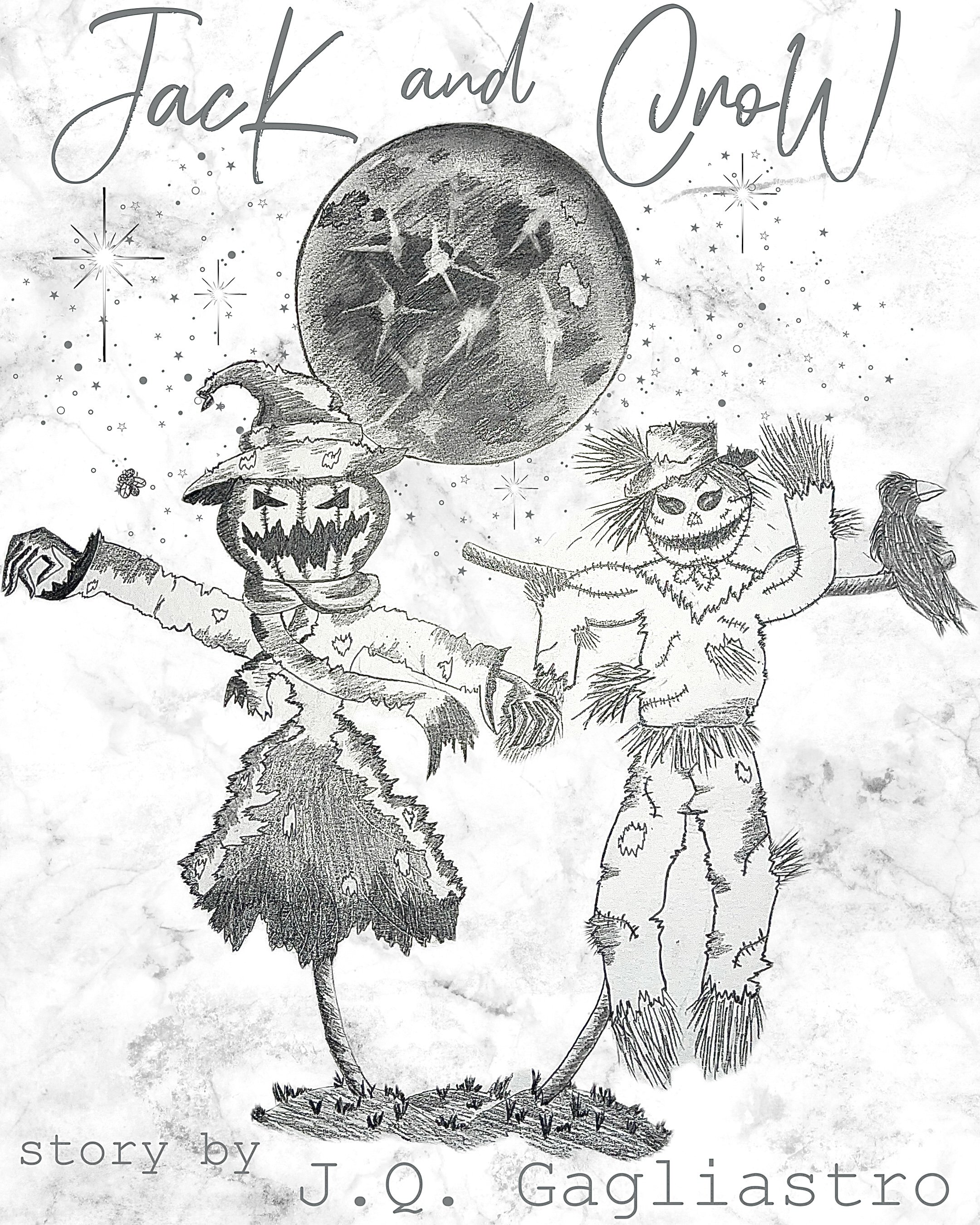
Though they adored each other very much, Jack never much liked how little Crow thought, and Crow never much liked how little Jack saw. While it was a feat to ignore these flaws, they never pointed them out to each other — that would be cruel.
Jack was born with a birth defect. He couldn’t walk for the longest time. Crow didn’t think twice about it. Perhaps Crow pitied him, sure. But he didn’t make a big deal about it and truthfully found Jack to be the only one on the farm who wasn’t tired and boring. Jack was always down for an adventure as long as Crow was by his side.
They were brothers. Half-brothers.
Jack’s mother was beautiful and stout. She passed when he was a mere seedling. She was loving, he recalled. All she wished for in life was to be a mother and that she became. She bore many children in her lifetime and wanted very dearly to watch them all grow. But that wish went by like a star. Life nodded gently at the wish and whispered to her dying bed that everything would be okay.
Some of her children were closer than others. But there was always love among them even when some left the farm for good. Jack happened to be the most distant from everyone. Though he was far, he admired their greatness every day.
Crow didn’t have a mother and again didn’t think twice about it.
Jack and Crow shared the same father. He was a brooding, lonely man, always galloping around the farm huffing at his litany of self-given work.
Jack was there the day Crow was born. He was young at the time and was jarred watching the birth.
Their siblings didn’t like Crow much and called him an airhead. He also looked too different from the pack, and that bothered them for some reason. But Jack didn’t care about looks. In fact, he took a page from Crow’s book and didn’t think twice about it.
One September day, while swaying to the buzz of a fly, Jack asked, “Do I dream too much?”
Crow itched his head. “Well,” Crow started, taking a thoughtful tone, “sometimes, you don’t always see.” He shrugged. “But it’s not a bad thing to be in your own little world. One could argue that it is healthy to have a place to escape to, to think. Some people don’t have a world of their own. They have to borrow someone else’s.”
Jack smiled at Crow. “Would you help me see better, brother?”
Crow smiled back. “Why, of course.”
For weeks, Crow brought Jack around the farm and pointed out things that Jack had never truly seen. He was amazed at all that he had overlooked — the architectural triumph of a spiderweb, the inverted parabola of a black cat’s spine, and the subtle nurturing ways their father would show his love.
The better Jack’s sight became, the deeper it carved into his soul.
The day after the great harvest, a small bird perched itself next to Crow. He had never seen a bird that close before and excitedly reached out for it, causing the bird to fly away.
“Why did I scare it so?” he asked his brother.
“Well,” Jack started, “you kind of lunged at it, Crow.”
“I did not lunge at it!”
“Did so. At least to the bird anyway.”
“What do you mean? Am I really that scary?”
“I don’t think that the bird flew away because you are scary,” said Jack, “but because it was scared. Unlike the bird, you are a tall being with arms great and long. It doesn’t understand you because it is not like you. If you want to hold the bird next time, perhaps it is best to let it come to you.”
Crow smiled at his brother. “Would you help me become as wise as you are, brother?”
“Oh goodness, that’s awfully kind of you. I-I don’t think I’m that wise—”
“But you are!” said Crow. “I’ve seen you grow in so little time. I want to grow like that.”
So, for weeks, Jack stuffed Crow’s head with many thoughts and ideas. They read philosophy and literature under light-dappled trees. They studied botany and agriculture and helped their father with the land. Crow even began writing his own stories. They were short stories, yes, but they contained his own thoughts, his own words, and that he has learned is what it is all about.
Maybe his head got a tad bigger, sure. But the more thoughts Crow consumed, the brighter his days became.
October was a busy month for the farm. It always is.
Jack and Crow helped their father more than anyone else. Jack sat by the driveway and brought customers in, while Crow kept the pests away from the crops.
When Halloween came, their father turned the cornfield into a haunted maze. While he hired actors to spook the patrons, Jack and Crow were the stars. They were placed in the center of the maze and together scared every child that dared cross their path.
In a blink, the show was over.
As they lay in the cornfield under the dead white moon, the brothers shared the same thought: Halloween is beyond the shadow of a doubt the best holiday.
Christmas passed, and the winter was brutal. Crow didn’t think Jack would make it. He was a frozen lump and could hardly move. Crow stood by him and never once left his side.
When spring returned, so did Jack. Despite this, Jack knew his time was coming. He saw his skin shrivel and wither away and his body lose its shape and structure. He was sad for himself but sadder for Crow and didn’t want his brother to see him this way. He told him to go, to leave him.
But of course, Crow stayed through it all. It’s not like Crow wasn’t getting to that age either. He was a lot thinner than he used to be, and no matter how much he stuffed himself, he could never keep on the weight.
The jack-o-lantern was the first to go. He collapsed in on himself and could no longer breathe.
Earth came and took him, and the wind carried his spirit to the mountains where he danced with his mother.
And when he was good and ready, the scarecrow got to his legs on a rainy April day, hobbled off into the cornfield, and thought his very last thought: Oh, how lucky was I to have a friend like you.
La Fin
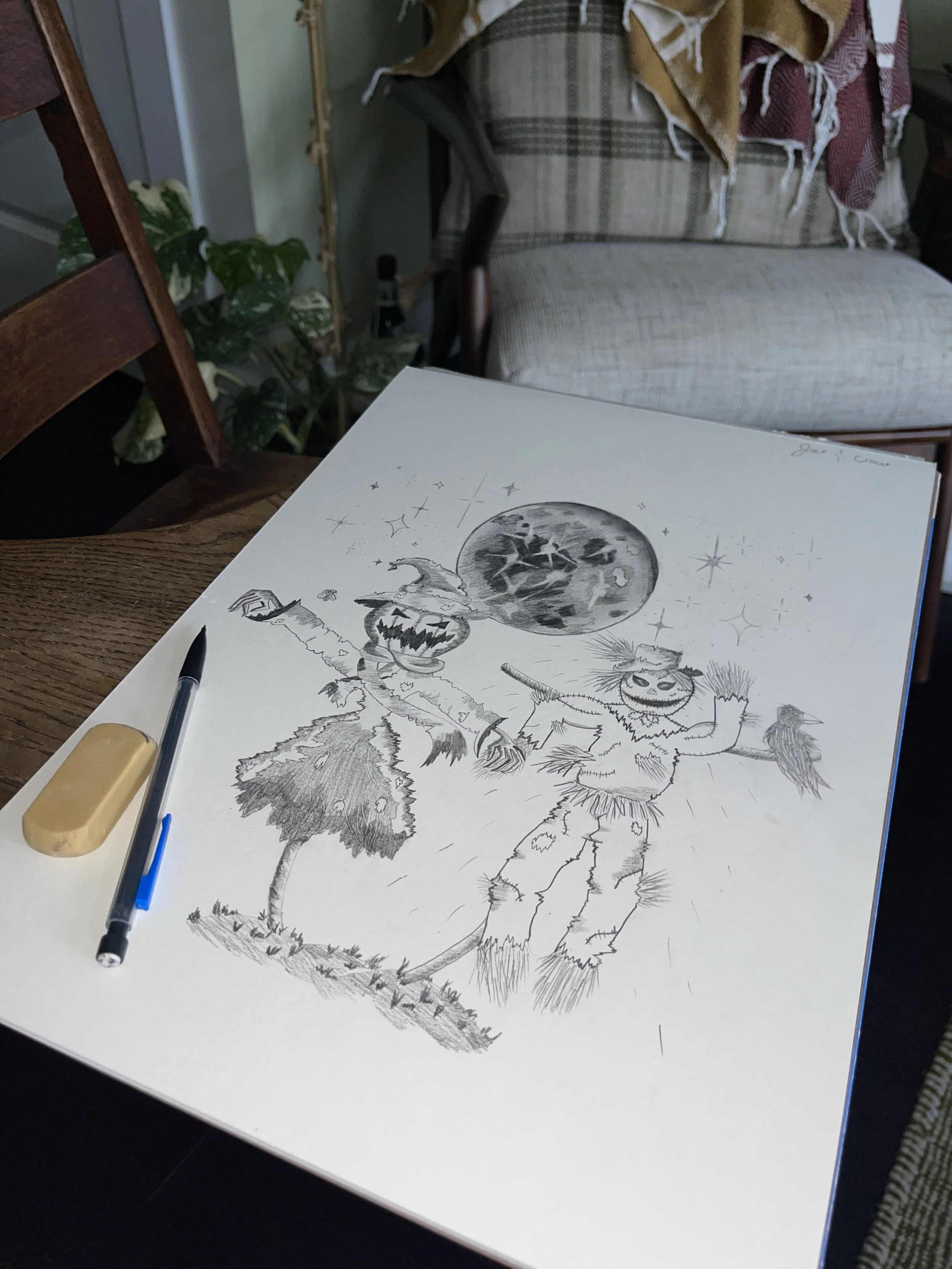
Illustrated by J.Q. Gagliastro